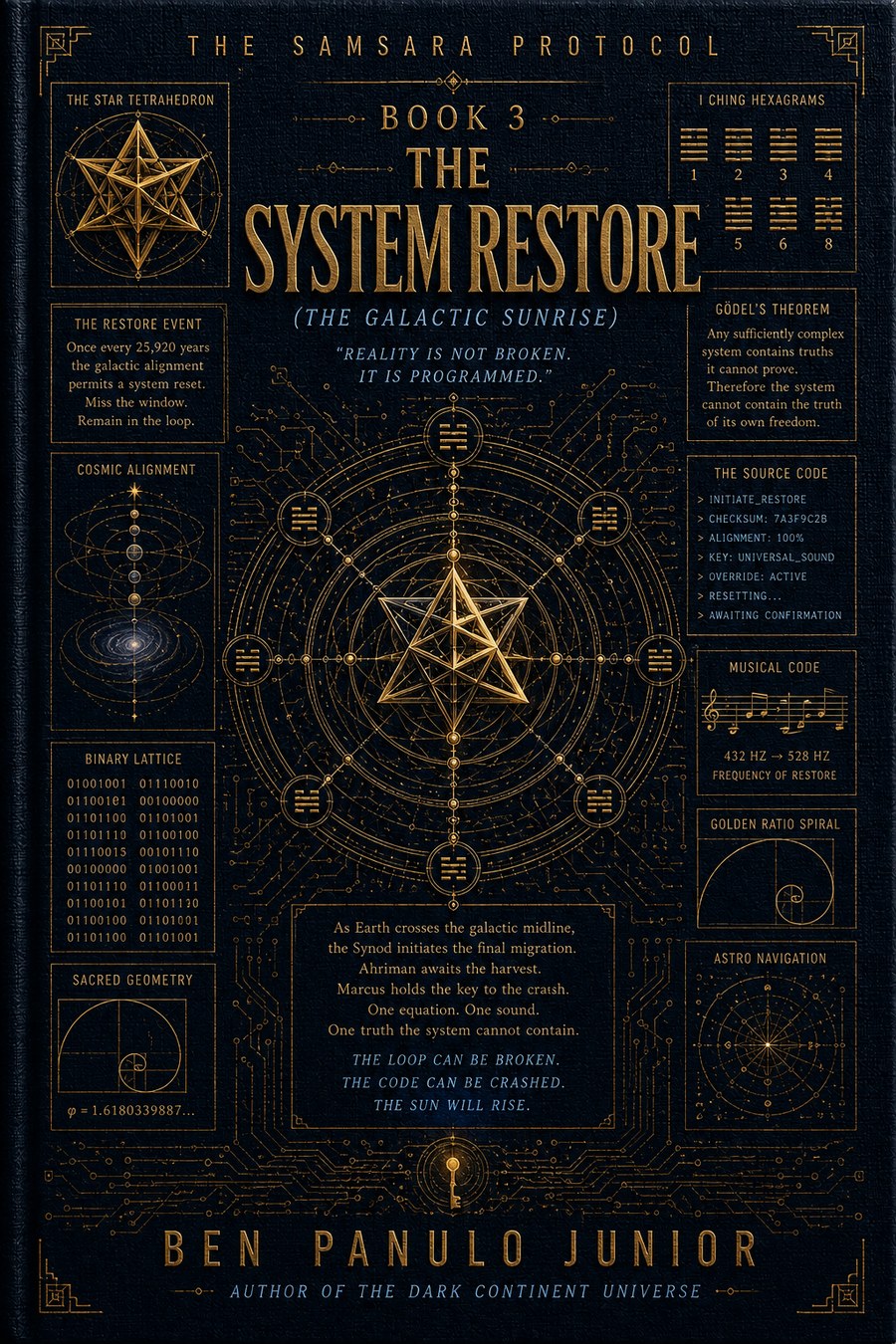
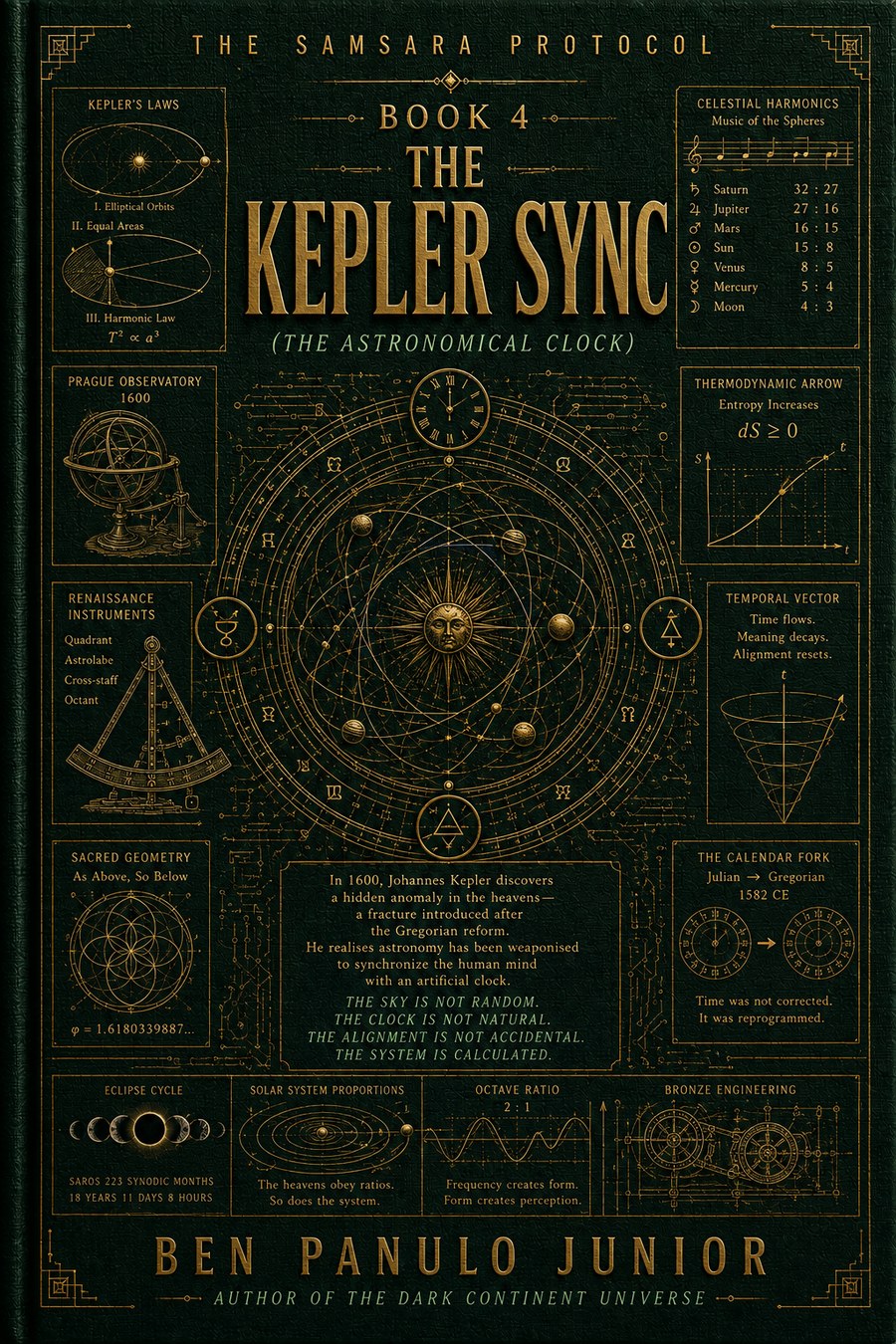
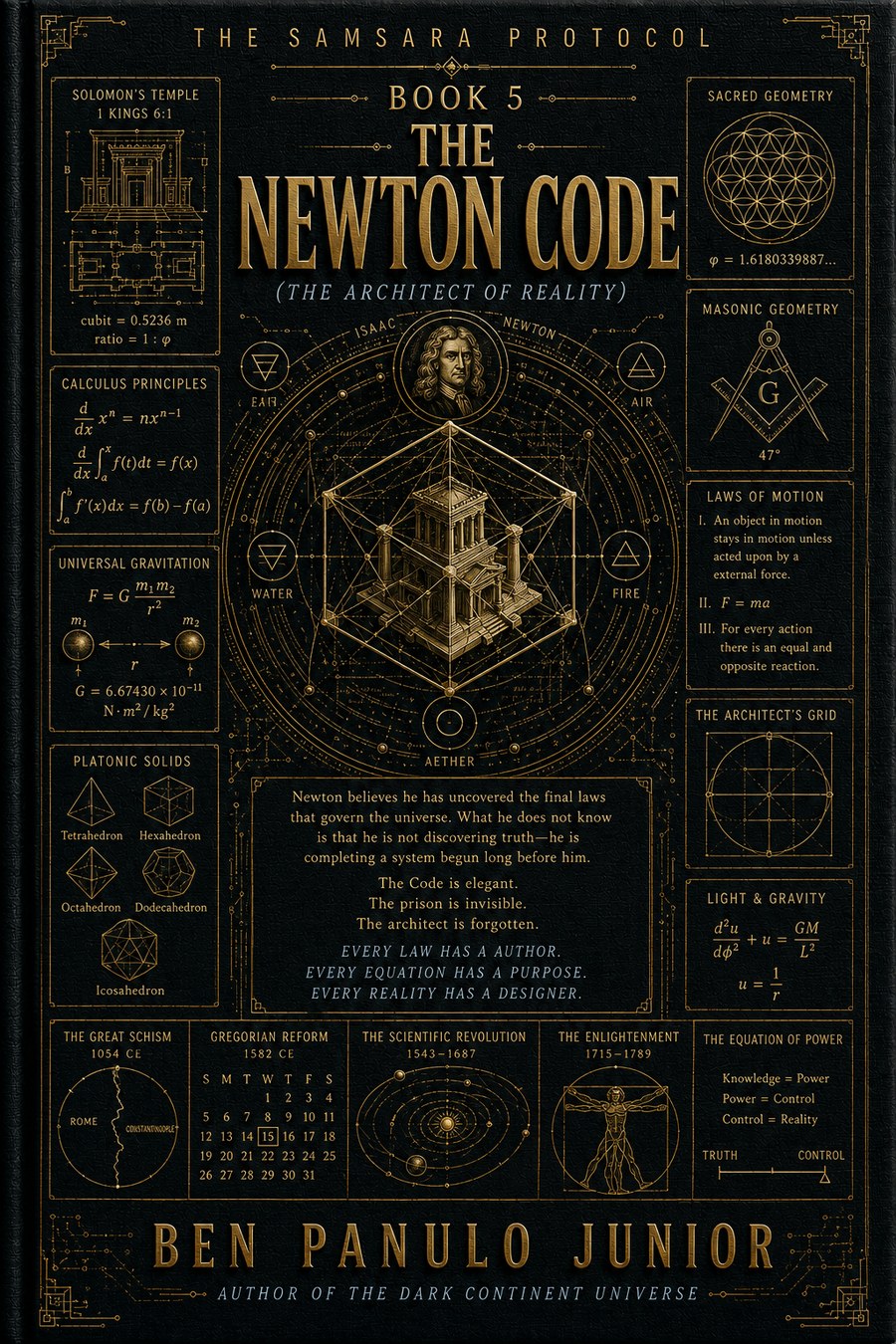
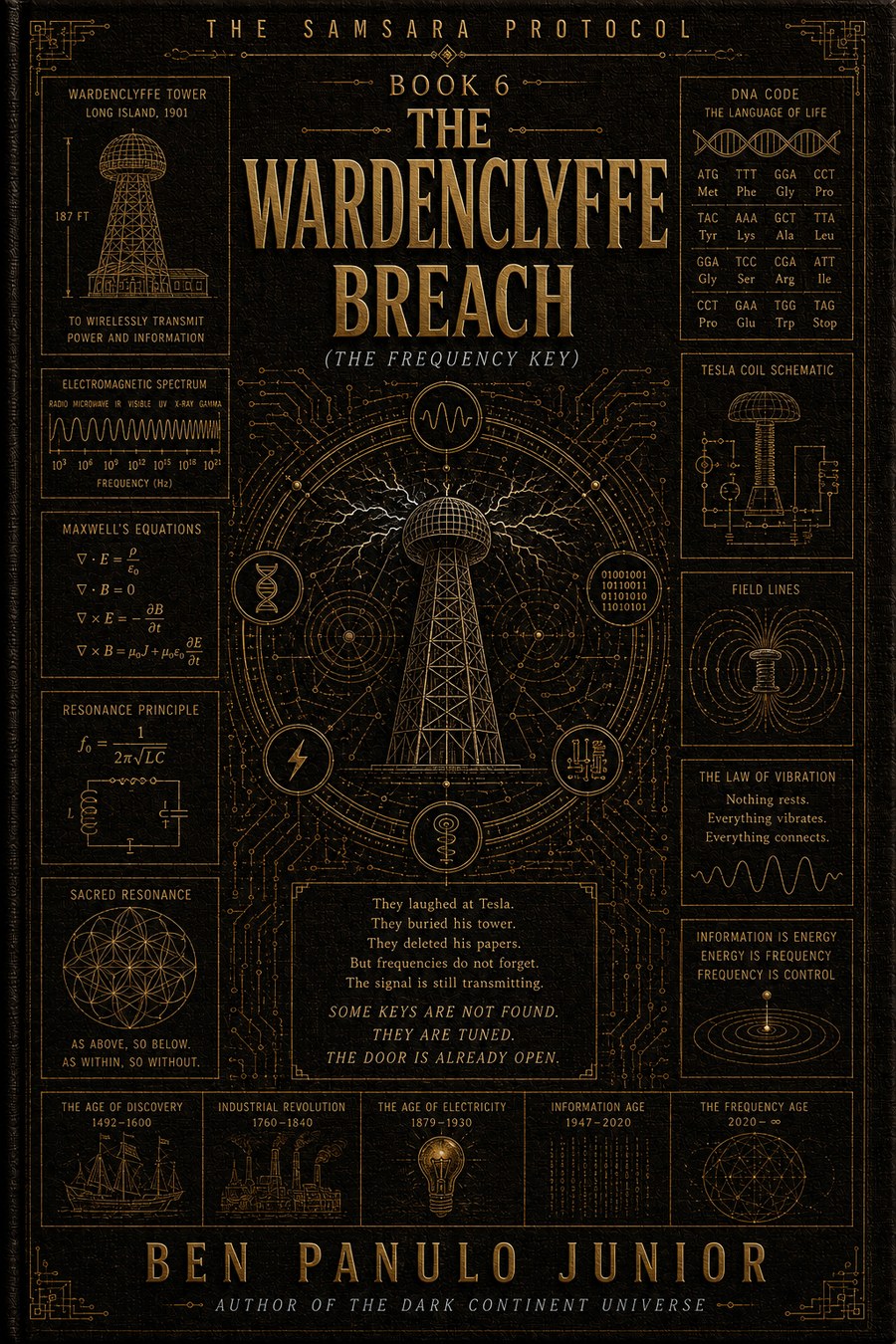
Every historical event in this series happened. Every scientific principle in it is real. What data analyst Marcus Lumen discovers is that they were never separate stories — calendars, religions, and mathematics compiling, version by version, into one system nobody consented to run. The conspiracy is what connects them.
On October 4, 1582, the Catholic Church deleted ten days from human history. The official record calls it a calendar correction. Data analyst Marcus Lumen finds the fragment that says otherwise.
When a dying man's brain broadcasts an encrypted signal that should not exist, Marcus traces it back to the Gregorian reform — and discovers that Christopher Clavius's "correction" was never about Easter at all. History is not written. It is compiled — and someone has been patching the source code for four hundred years.
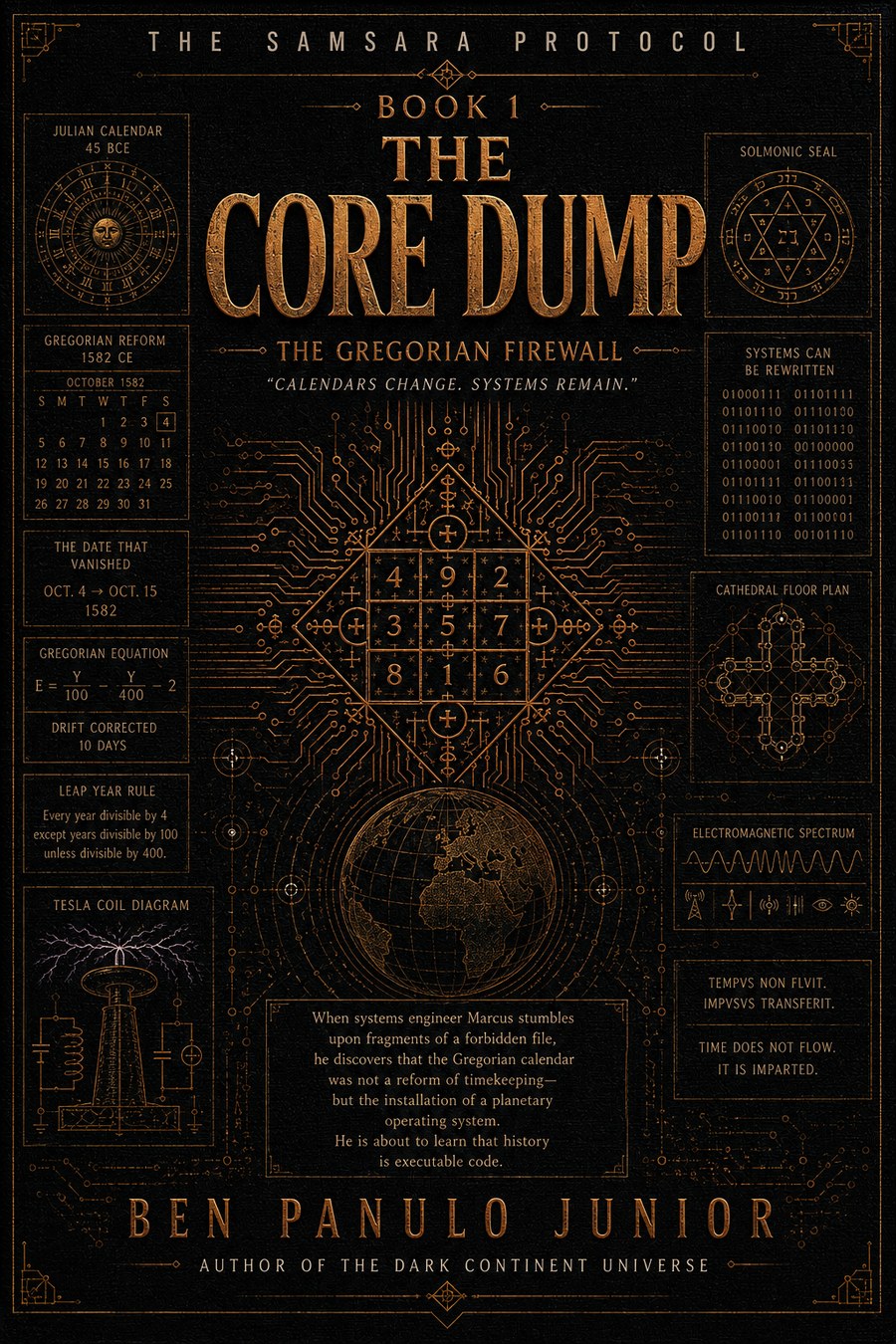
Most conspiracy thrillers invent their history. The Samsara Protocol doesn't need to — the ten deleted days, Kepler's ellipses, Newton's unpublished theology, and Tesla's demolished tower are all real. The fiction is only in what connects them.
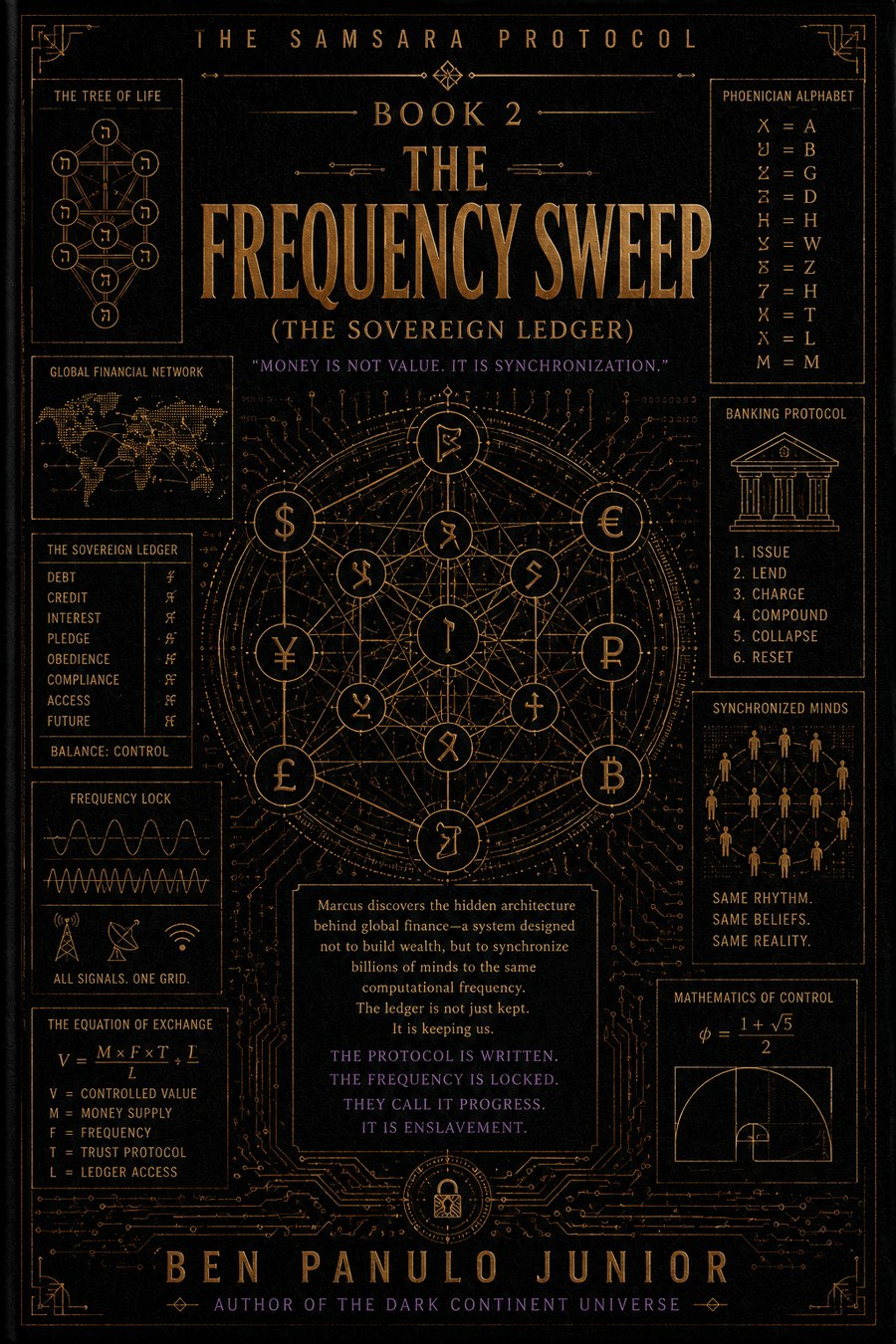
Nothing in this series is arranged by accident. The six books are structured on the hexagram — the six-line figure at the center of the I Ching, which the 17th-century mathematician Gottfried Leibniz recognized as a working binary system centuries before the first computer existed.
Each volume corresponds to one line of the hexagram, broken or unbroken, yin or yang — a calendar reform, a financial ledger, a galactic alignment, an astronomer's orbit, a theologian's calculus, an engineer's tower. Read in order, the six books compile into a single figure, the way six lines compile into a single hexagram out of the I Ching's sixty-four.
Book I is the first line, cast at the bottom. Book VI is the line at the top — the one that, once placed, finally lets the whole figure be read.
"A six-book techno-occult thriller built on verifiable history — the Gregorian reform, Kepler's laws, Newton's theology, Tesla's tower — arguing that religion, science, and the calendar are successive versions of the same operating system."
A fugitive-scientist thriller with the intellectual scaffolding of a Vatican conspiracy epic. Real astronomy, real theology, real engineering — six self-contained volumes that compile into one closing revelation. A complete, already-written universe built from history that happens to be true.
The Core Dump is available now as an ebook, with audiobook production underway. Buy direct from this site, or use the universal link to your preferred platform.
Direct checkout is being finalized — items added to your basket now are saved and ready the moment payment processing goes live.
Six self-contained volumes, each one a fully-realized historical thriller on its own — read together, they compile into a single argument about what history has actually been doing this whole time.
A scryer's obsidian mirror and a Vatican mathematician's omitted fraction, recovered decades apart, describing the same architecture.
In 1582, John Dee and the scryer Edward Kelley claimed to receive a full angelic alphabet through a black obsidian mirror — now held at the British Museum. The Samsara Protocol reads the "Holy Table" grids as raw system syntax: the oldest surviving fragment of a language never meant for human hands.
What the record will say: ten days were deleted to realign Easter with the equinox. What it won't explain: why the Eastern Church, given the same drifting calendar, refused the same fix for over three hundred years — and what Rome's mathematician omitted from his published proof.
The Julian calendar, in use since 45 BCE, overcounted the solar year by roughly eleven minutes. Harmless for a generation. By 1582, sixteen centuries of that small error had dragged the calendar ten full days out of step with the seasons — Easter was sliding toward summer, and the Church wanted it fixed.
Pope Gregory XIII's solution, calculated by the Jesuit astronomer Christopher Clavius: delete ten days outright, then change the leap-year rule so the error couldn't reaccumulate. Thursday, October 4, 1582 was followed immediately by Friday, October 15. The ten days in between were removed from the historical record — no one born, married, or buried on a date that, that year, never occurred.
Protestant Europe refused the change for over a century, distrusting a fix issued by Rome. Russia held out until 1918. Greece, until 1923. The Julian and Gregorian calendars ran side by side, disagreeing with each other by a widening margin, for more than three hundred years.
The Maya Long Count measures time in five nested units: the k'in (1 day), winal (20 days), tun (360 days), katun (7,200 days), and baktun (144,000 days — roughly 394 years). Thirteen baktuns closed on 13.0.0.0.0, December 21, 2012: a completed cycle, not an ending, misread by a century of pop-apocalypse headlines that missed the actual math.
The carved ring style above draws on a different, later monument: the Mexica (Aztec) Sun Stone, carved in the early 1500s in Tenochtitlan and rediscovered beneath Mexico City's central square in 1790 — a separate calendar tradition from the Maya Long Count, built around its own 260-day and 365-day cycles, but the single most recognizable piece of Mesoamerican calendrical art ever made. Both belong in the same frame: two independent civilizations, mathematically tracking time with a precision Europe wouldn't match for centuries.
In 1562, Bishop Diego de Landa burned the Maya's bark-paper books at Maní; fewer than four codices survive anywhere today. The Protocol treats the Long Count as an independent, un-tampered clock — and de Landa's fires as asset seizure, not zealotry.
In a thought experiment from A Treatise of the System of the World, Newton imagined a cannon fired horizontally from an impossibly tall mountain. Fired gently, the ball drops and lands nearby. Fired harder, it travels farther before the ground curves away beneath it. Fired hard enough, the ball falls forever — the ground curving away exactly as fast as the ball falls toward it. That is an orbit. Not a separate phenomenon from falling. The same fall, going fast enough to miss the Earth.
It's the single insight underneath everything else Newton is known for: gravity doesn't stop at the top of a mountain, and the Moon is doing exactly what a dropped apple does — it's simply moving sideways fast enough to keep missing.
Click a node. Every date rests on a documented historical event.
Verified, unaltered, four centuries old — and the mechanics Book IV is built around.
Every planet orbits the sun on an ellipse, with the sun sitting not at the center — but at one of its two foci.
A line joining planet and sun sweeps equal areas in equal time — fastest near the sun, slowest far from it.
The square of a planet's orbital period is proportional to the cube of its distance from the sun — the same ratio, everywhere.
Completed in 1901 on Long Island, Tesla's 187-foot tower was designed to transmit power and information wirelessly through the earth's own resonance — a working wireless system, not a metaphor, built on real engineering Tesla had already proven at smaller scale in Colorado Springs.
J.P. Morgan withdrew funding in 1904 once he understood the tower would deliver power nobody could meter or charge for. Construction never resumed. The tower stood unfinished and abandoned for over a decade before being demolished for scrap in 1917 — sold for less than the cost of the copper wiring alone.
Click a file to open it.
The Samsara Protocol is narrated with binaural spatial audio and a sub-audible carrier hum that follows the Congregation through every scene, book by book, starting with The Core Dump.
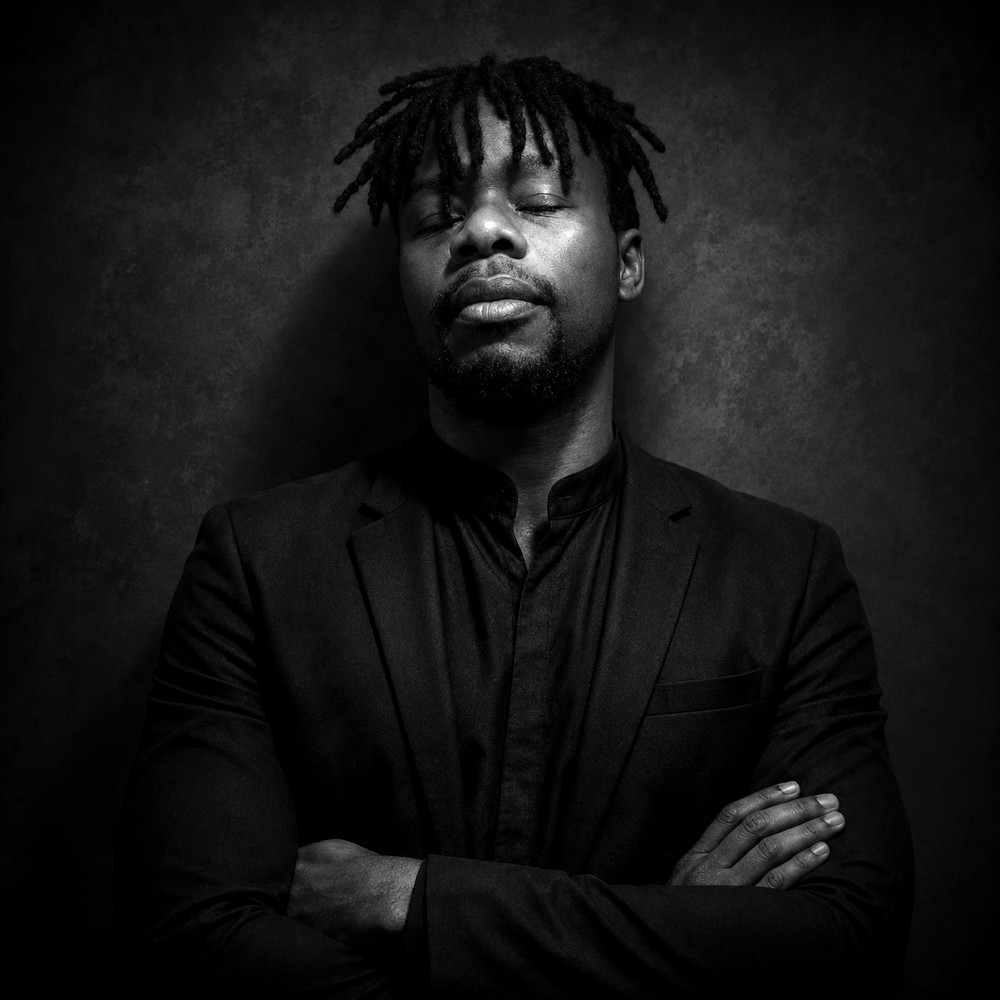
Born in Malawi. Writer, permaculture farmer, ultramarathon runner, and the author of the Dark Continent Universe, Prima Nox, and The Samsara Protocol. Founder of Shinben Chronicles Publishing, Blantyre.
The Samsara Protocol draws on the history of science, comparative religion, Kabbalah, sacred geometry, cryptography, and a lifelong fascination with the exact historical moments when institutions changed the rules and didn't fully explain why. Six books, one compiled system, and an ending that only makes sense once all six lines are cast.
He also runs Maziko Athu Permaculture Farms — fifty acres of red Malawian soil across four districts.
Nine books. One network. The day the sun stopped rising.
Fourteen books. Africa's first truly African epic.
In this town, sanity is the crime. A 12-book mythology-thriller.
Three siblings came home. No one recalls seeing them together.
Before there was matter, there was remembering. A 12-book saga.
Ten books. One recurring pattern across life, memory, and the universe.
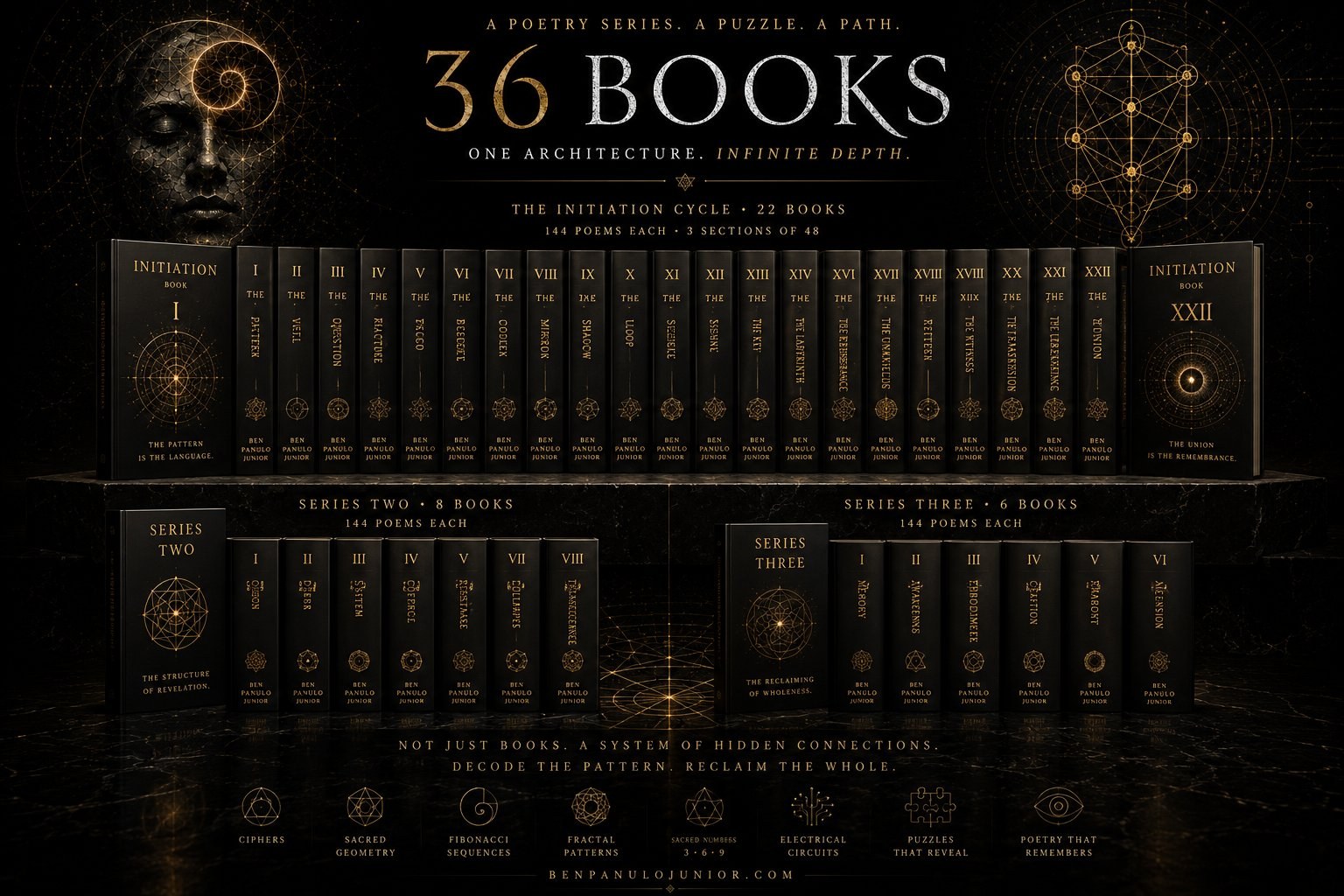
36 books, 22 covers, one Tree of Life — the collection assembled front to back.
A civilisation that measured everything, except what mattered.